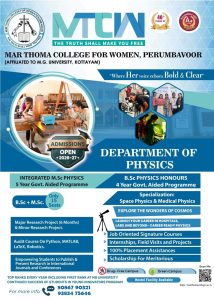
The Department of Physics has been an integral part of Mar Thoma College for Women, Perumbavoor, since the inception of the Science programmes in the institution. Over the years, the department has evolved into a vibrant centre for teaching, learning, and research, offering the B.Sc. Physics (Honours) programme with specialization options in Medical Physics and Space Physics, as well as the Integrated M.Sc. Programme in Basic Sciences – Physics (B.Sc.+M.Sc.) with specialization in Materials Science. In addition, the department offers a variety of core, multidisciplinary, and complementary courses for students of Physics, Mathematics, Chemistry, and other disciplines.
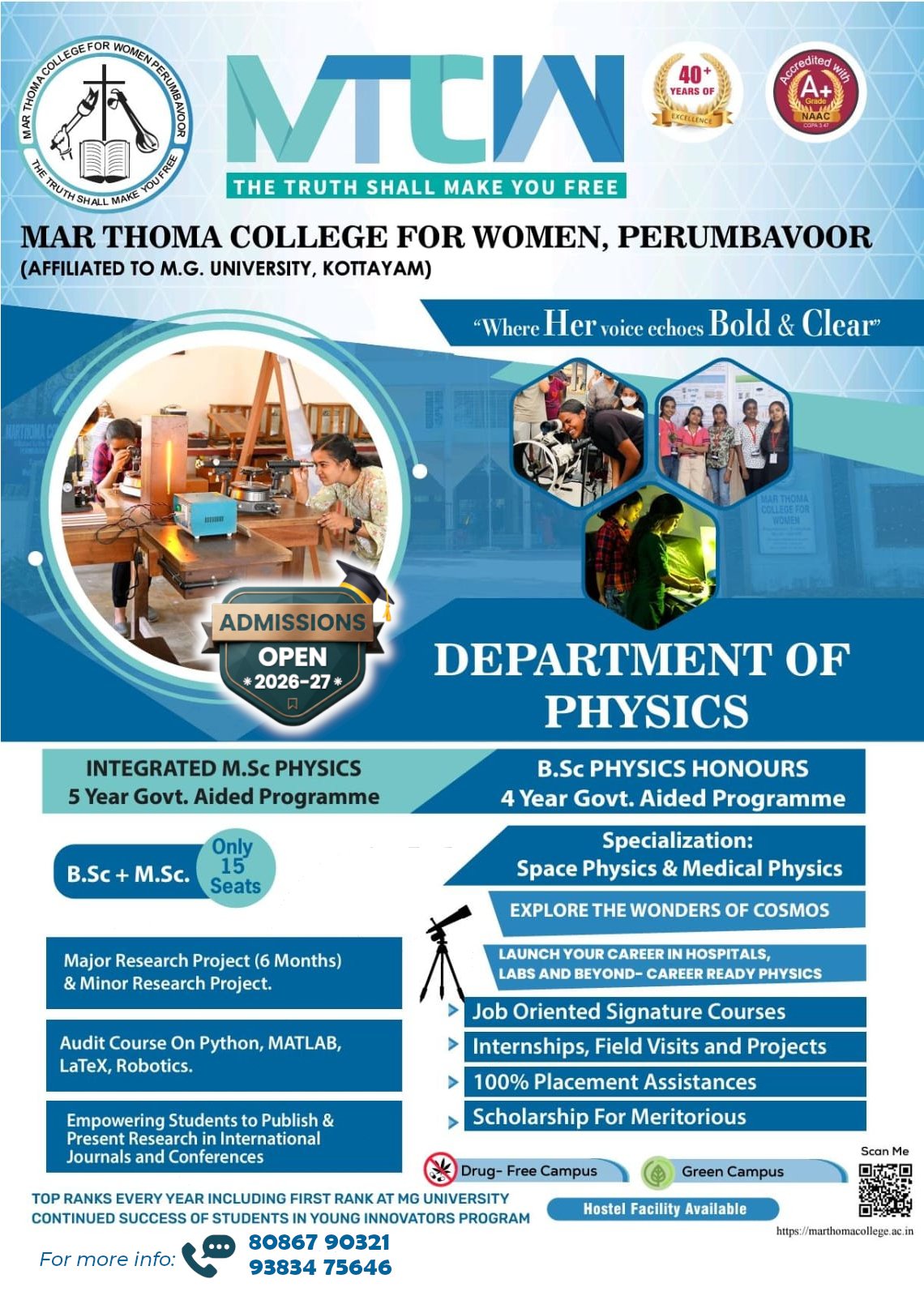
Department of Physics
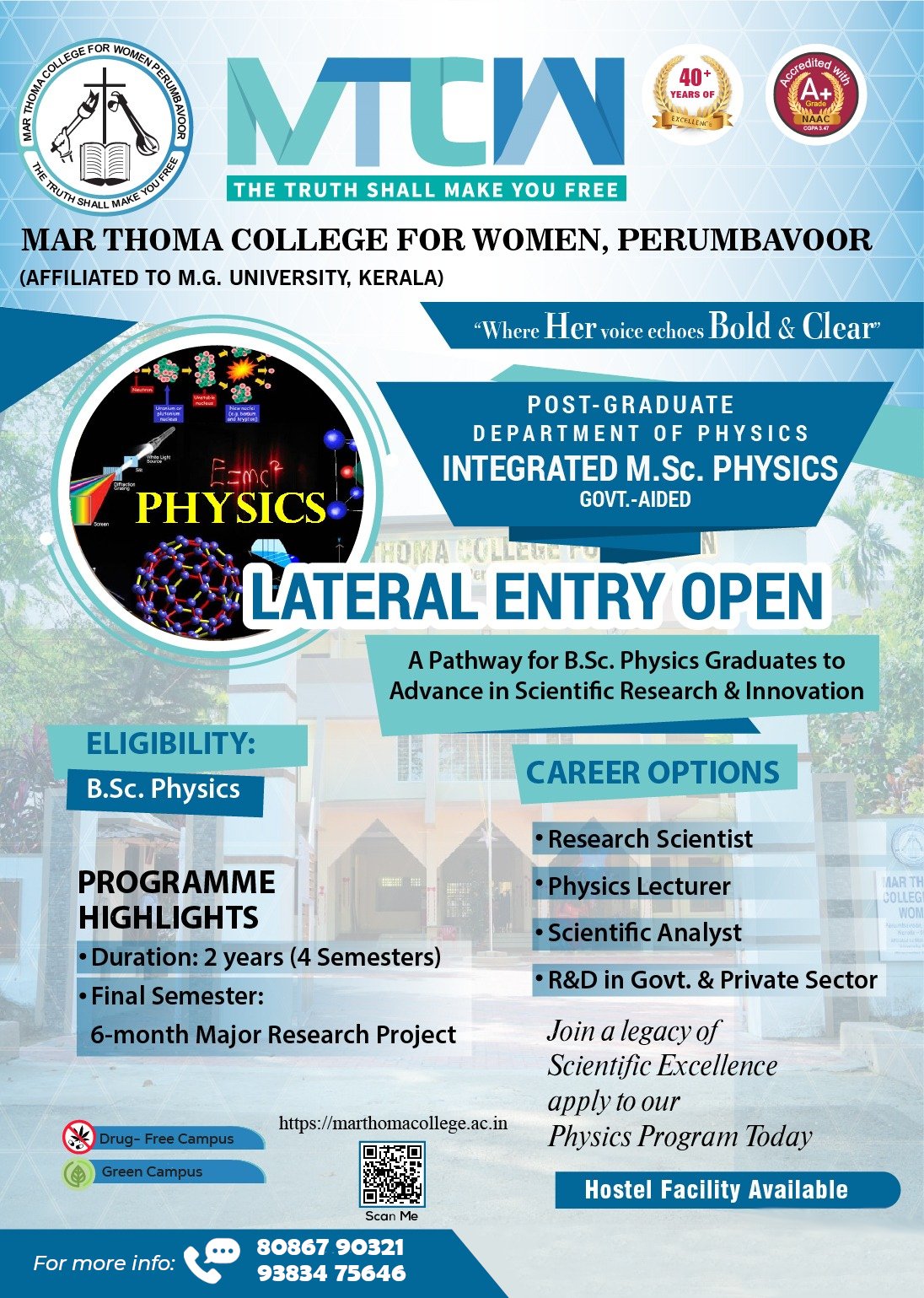
Lateral Entry Open to Integrated MSc Programme in Basic Science-Physics, 2026
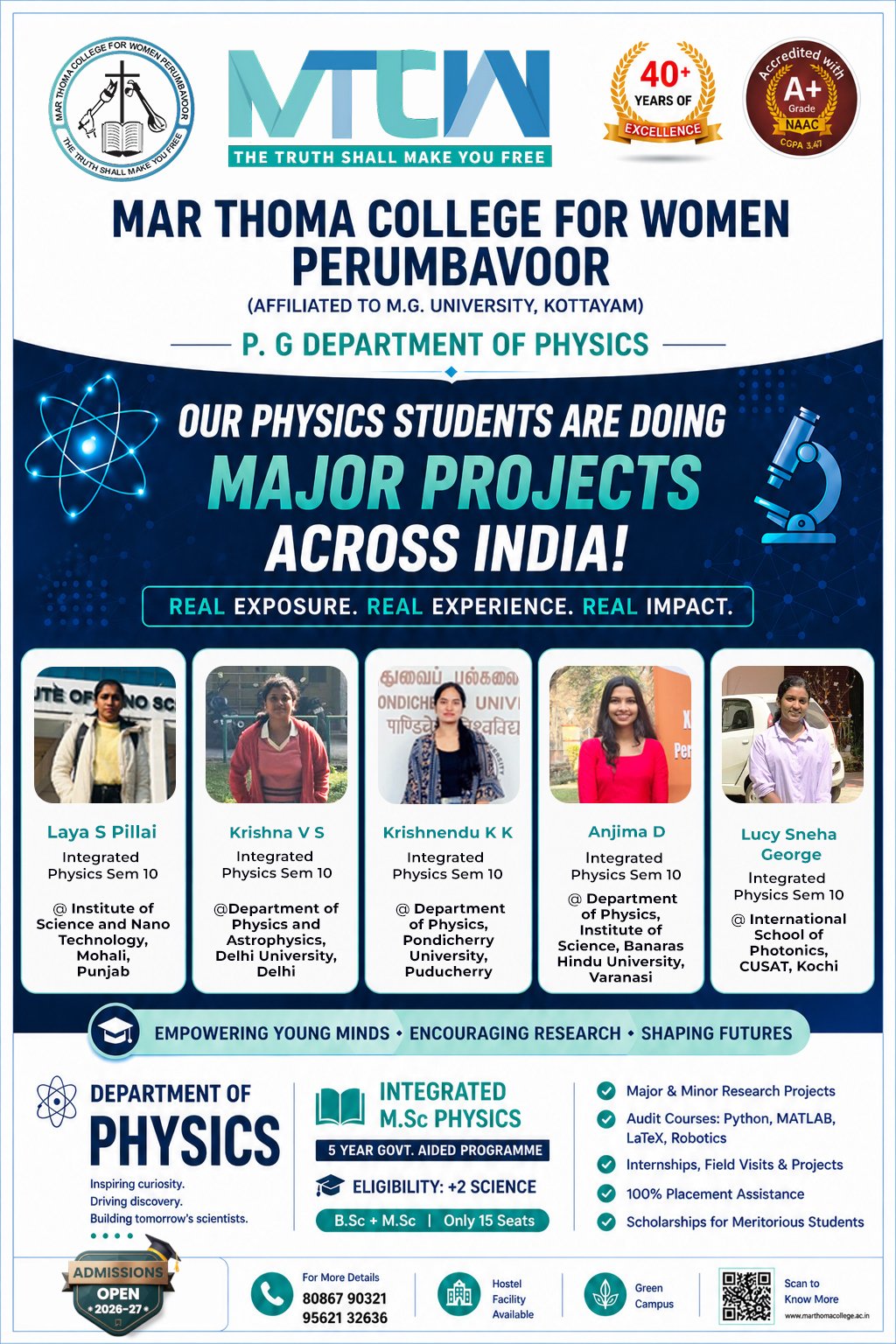
Integrated MSc Students Major Project
 |
 |
| Sl. No. | Programmes Offered | Specialization |
| 1 | 5 Year Integrated M. Sc. Physics (B.Sc.+M.Sc.) | Material Science |
| 2 | 4 Year B. Sc. (Hons.) in Physics | Medical Physics and Space Science |
| 3 | 4 Year B. Sc. (Hons. with Research) in Physics | Medical Physics and Space Science+ Research in Nanoscience and Nanotechnology |
| 4 | 3 Year B. Sc. Physics |
| Reports | |
The Department of Physics has been in existence since the inception of the Science programmes at Mar Thoma College for Women, Perumbavoor. Over the years, the department has established itself as a centre of academic excellence, offering quality education in Physics and contributing significantly to the scientific and intellectual growth of students. The department offers various core, multidisciplinary, and complementary courses for undergraduate programmes in Physics, Mathematics, Chemistry, and other disciplines.
The Department started the B.Sc. Physics (Vocational – Model II Applied Electronics) programme in 2001 with an intake of twenty-one students. The programme quickly gained recognition for its academic excellence, with two students from the very first batch securing First and Third Ranks in Mahatma Gandhi University. Since then, the department has consistently maintained an excellent academic record, producing university rank holders and outstanding graduates.
In line with the implementation of the Four-Year Undergraduate Programme (FYUGP) under the National Education Policy (NEP) 2020, the department now offers B.Sc. Physics (Honours) with opportunities for specialization in emerging and interdisciplinary areas. Students can pursue specialization tracks in Medical Physics and Space Physics, enabling them to acquire advanced knowledge and practical skills relevant to contemporary scientific and technological developments.
The Medical Physics specialization introduces students to the applications of physics in healthcare and medicine. The curriculum covers areas such as radiation physics, medical imaging, radiation safety, nuclear medicine, radiotherapy, and diagnostic instrumentation. This specialization prepares students for higher studies and careers in hospitals, research institutions, healthcare technology industries, and radiation safety organizations.
The Space Physics specialization provides students with an understanding of the physical processes governing the Sun, planetary systems, interplanetary space, and the Earth’s atmosphere. Topics include astrophysics, space weather, satellite technology, planetary science, remote sensing, and observational astronomy. The programme equips students with the knowledge required for advanced studies and careers in space science, astronomy, atmospheric research, and related technological sectors.
In 2021, the Government of Kerala sanctioned the innovative Integrated M.Sc. Programme in Basic Sciences – Physics (B.Sc.+M.Sc.) in the aided stream. The programme offers an integrated pathway to postgraduate education and emphasizes interdisciplinary learning, research aptitude, and scientific innovation. The programme provides specialization in Materials Science, a rapidly advancing field that focuses on the design, characterization, and application of advanced materials. Students are exposed to topics such as nanomaterials, polymers, semiconductors, functional materials, thin films, energy materials, and modern characterization techniques, preparing them for careers in research, industry, and higher education.
The research activities of the Department are highly commendable. Two faculty members serve as recognized research guides. The Department has successfully conducted internship programmes aligned with the Four-Year Undergraduate Programme (FYUGP), providing students with valuable research and industry exposure. In addition, the Department’s laboratory and research facilities have been extensively utilized by numerous Ph.D. scholars and postgraduate students for the successful completion of their dissertation and research work. These activities reflect the Department’s strong commitment to fostering a vibrant research culture and promoting academic excellence.
The Department has been fortunate to have a team of dedicated and accomplished teachers since its inception. At present, the department comprises four permanent faculty members and five government guest (in contract) faculty, all committed to academic excellence, research, and student development. Despite being a relatively small department with nearly sixty students, it maintains a vibrant academic atmosphere through regular seminars, workshops, invited lectures, outreach activities, and social commitment programmes.
The Department actively collaborates with and receives support from prestigious agencies such as the University Grants Commission (UGC), Kerala State Council for Science, Technology and Environment (KSCSTE), Department of Science and Technology (DST), Government of India, Energy Conservation Society, and other scientific organizations. These collaborations provide students with valuable opportunities for exposure to current scientific developments, skill enhancement, research orientation, environmental awareness, and community engagement.
Through its commitment to academic excellence, research, innovation, and social responsibility, the Department of Physics continues to nurture scientifically competent, socially responsible, and professionally skilled graduates capable of contributing meaningfully to society and the scientific community.
Best Practices
- Vocational Education Training
- Energy and Environmental Protection